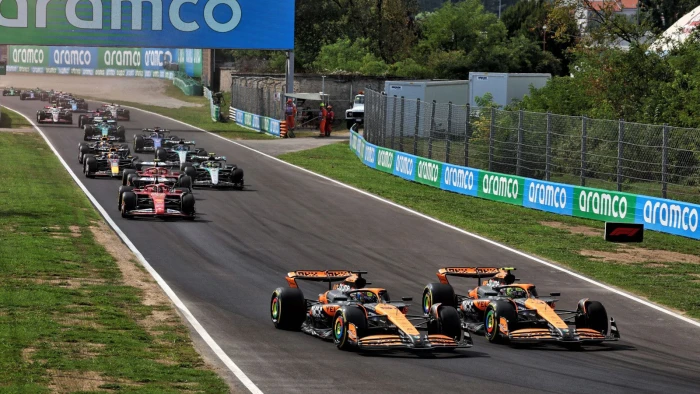
Lando Norris explains weakness in McLaren Formula 1 car despite recent upgrades

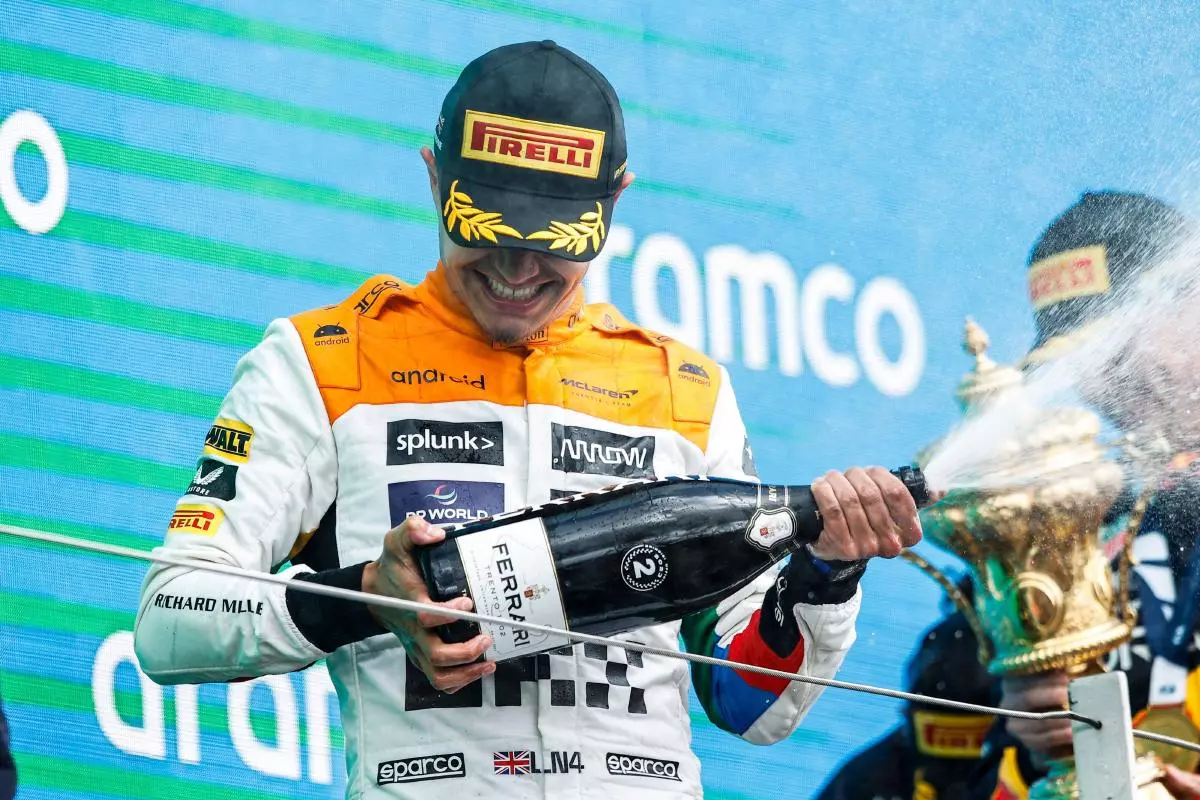
Lando Norris celebrates finishing second at the British Grand Prix - July 2023
Lando Norris has unveiled a persistent flaw within the McLaren racing machine that has persisted for nearly half a decade.
Lando Norris, the talented McLaren Formula 1 driver, has unveiled a persistent flaw within the McLaren racing machine that has persisted for nearly half a decade.
The McLaren team experienced a noteworthy shift in their form during the Austrian Grand Prix, as an extensive series of enhancements were introduced to the MCL60. This marked a significant turnaround for the squad after a sluggish commencement to the F1 season.
Following the implementation of these upgrades, McLaren's performances skyrocketed, amassing 86 points across four Grand Prix weekends, a feat highlighted by consecutive podium placements in the British and Hungarian races.
Despite the apparent progress in the team's overall performance, Norris remains steadfast in his conviction that McLaren must confront and eliminate the enduring vulnerability that continues to plague their vehicle.
"In spite of these advancements, the driving experience and handling of the car haven't witnessed any discernible enhancement," Norris articulated during a media interaction before his second-place triumph in Hungary.
"The vehicle is still equally challenging to pilot and execute optimal Qualifying laps."
"In essence, the situation has somewhat improved, particularly due to our elevated position in the hierarchy over the past few weekends in case a mistake occurs.
"In the context of high-speed corners, the margin for error has reduced due to the car's improved performance. While we've succeeded in enhancing the car's speed, I'd rather exercise caution and avoid getting ahead of ourselves. After all, we've encountered only two weekends where we've demonstrated exceptional speed.
"Over the past five years, however, we've failed to address the deficiency in slow-speed handling and drivability.
"For me, the true breakthrough would entail refining our approach to driving the car, striving to enhance its user-friendliness, rather than merely adding a marginal ten points of load in slow-speed corners.
"Such measures can only propel us to a certain position within the order.
"Others may share similar sentiments, but we must acknowledge that our vehicle is among the least competitive in terms of slow-speed corners.
"This particular aspect has consistently posed a challenge for us over the last five years, and our efforts to tackle it haven't been particularly successful.
"We've never reached a point where we could confidently assert that our slow-speed performance was impressive, prompting us to shift focus towards improving high-speed capabilities.
"Our prowess in high-speed scenarios has consistently stood out, but our performance in slow-speed situations has faltered."
Norris also delved into the influence of Pirelli tires on vehicle design. He asserted that a positive cycle can be established if the overall car package is elevated.
"Furthermore, there's a noteworthy correlation with the tires. They necessitate a specific style of driving, one that's somewhat challenging to combine, given their propensity to prefer straight-line motion over cornering."
"Nevertheless, if we succeed in enhancing the vehicle itself, we can alleviate the strain on the tires and optimize their performance."
With the Formula 1 season presently on a summer hiatus, action will resume with the Dutch Grand Prix scheduled for the 28th of August at Circuit Zandvoort.